Baby Fever Guide for New Parents
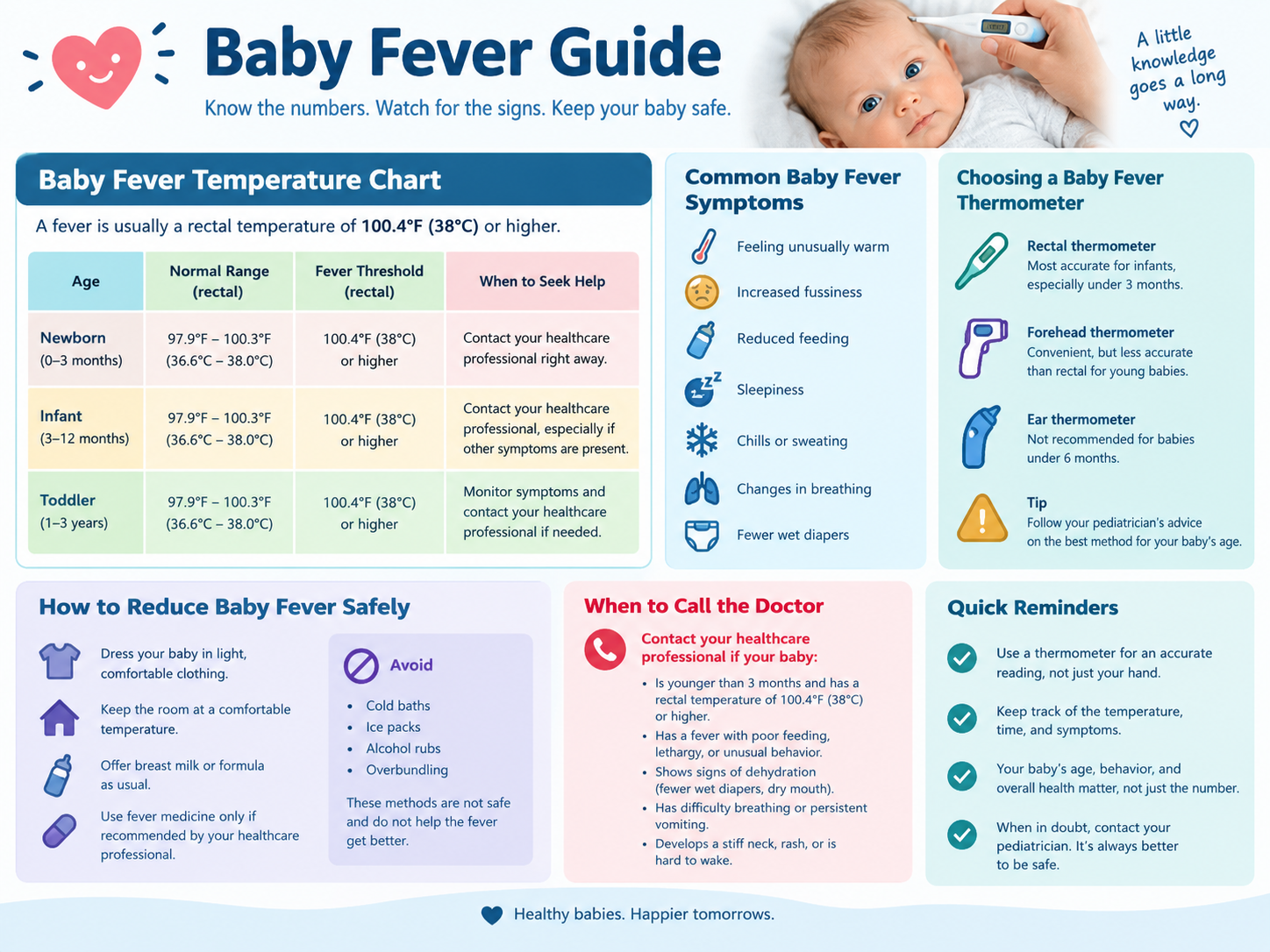
Baby fever guide temperature chart for new parents.
A baby fever is generally defined as a temperature of 100.4°F, or 38°C, or higher when measured rectally. For infants 3 months or less, a rectal temperature of 100.4°F or higher requires immediate contact with a healthcare professional. Parents should watch for poor feeding, fewer wet diapers, unusual sleepiness, breathing difficulty, persistent vomiting, or other signs of serious illness.
RELATED: How to Get Your Baby to Sleep Faster (digital E-book)
What is a true baby fever? When does a new parent with a baby with a high temperature become concerning?
This Baby Fever Guide explains baby fever temperature, baby fever symptoms, baby fever thermometer readings, fever in babies, fever in newborns, and how to respond when your baby's temperature rises.
This guide is not to be a replacement for any kind of medical authority. If you have any concerns, please call your pediatrician or seek urgent care.
What Counts as a Baby Fever Temperature?
A baby fever temperature requires an actual thermometer reading. Relying on using your hand on your baby's forehead is not sufficient.
For most infants, a rectal temperature of 100.4°F, or 38°C, or higher qualifies as a fever.
The American Academy of Pediatrics identifies a rectal temperature of 100.4°F or higher as a fever and considers rectal measurement especially reliable for young infants. [1]
Your baby's age matters as much as the number on the thermometer.
A temperature that deserves immediate medical attention in a newborn follows a different decision process from a fever in an older infant.
This is one reason parents should record both the temperature and the baby's age when contacting a healthcare professional.
A single borderline reading also deserves context.
Your baby might have been bundled tightly, crying, feeding, or recently exposed to a warm environment.
Rather than guessing, wait according to your pediatrician's instructions and obtain another measurement using the same method.
Baby Fever Temperature Chart for Different Ages
A useful baby fever temperature chart should help you make decisions, not create false reassurance.
For a baby younger than 3 months, a rectal temperature of 100.4°F or higher warrants immediate contact with the baby's healthcare professional.
The American Academy of Pediatrics advises prompt evaluation for infants in this age group with a temperature at or above 100.4°F. [1]
For older infants, the temperature itself is only one part of the assessment.
Feeding, hydration, breathing, alertness, skin color, urine output, and overall behavior provide important information.
A baby with a lower temperature but significant breathing difficulty deserves more attention than a comfortable, alert baby with a modest fever.
Your Baby Fever Guide should therefore treat age, measurement method, temperature, and symptoms as a single picture.
Avoid using a single number as the only measure of how sick your baby is.
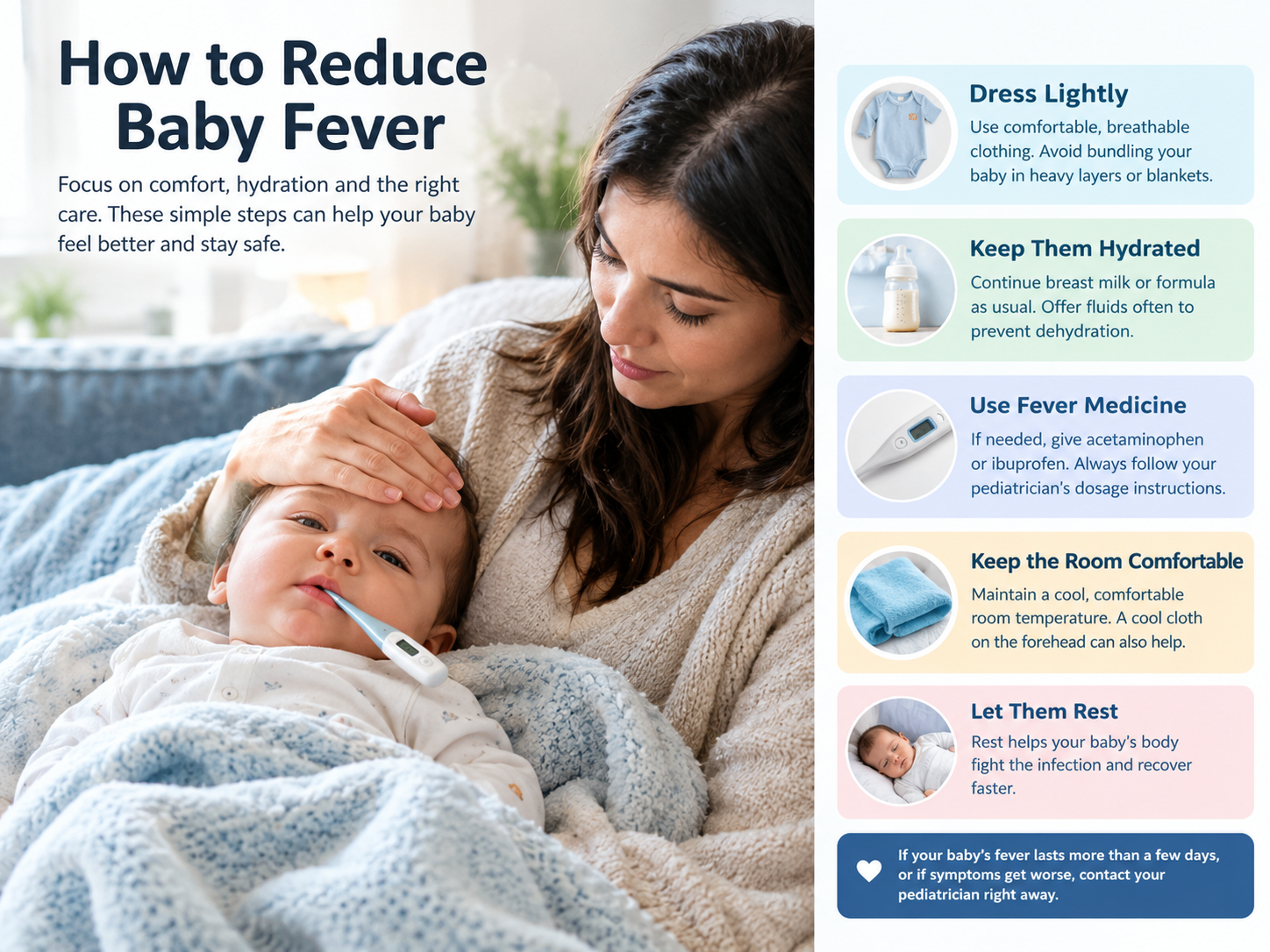
A picture showing how to reduce baby fever.
Baby Fever Symptoms Parents Should Watch
Common baby fever symptoms include feeling unusually warm, increased fussiness, reduced feeding, sleepiness, chills, sweating, or changes in normal behavior.
Fever itself is a body response, so the underlying illness matters more than the temperature alone.
The American Academy of Pediatrics notes that common causes of fever in babies include respiratory infections, ear infections, urinary tract infections, gastrointestinal infections, influenza, RSV, croup, and pneumonia. More serious causes include sepsis and meningitis. [1]
Pay close attention to behavior.
A baby who remains reasonably alert, feeds adequately, produces wet diapers, and responds normally provides different information from a baby who becomes difficult to wake, refuses multiple feeds, or shows breathing problems.
Parents sometimes focus so heavily on the thermometer that they overlook these changes.
Your observations between temperature checks provide valuable information for your baby's healthcare professional.
Choosing a Baby Fever Thermometer
A baby fever thermometer needs to provide a dependable measurement for your baby's age.
Rectal measurement is especially important for young infants because it provides a reliable core temperature reading.
The American Academy of Pediatrics states that rectal temperatures are the most accurate readings for infants, especially babies younger than 3 months. [1]
A baby fever thermometer used on the forehead, ear, or under the arm might produce a different number from a rectal measurement.
This difference does not automatically mean one device is defective. Measurement location and technique affect the result.
The AAP advises against relying on ear thermometers for babies younger than 6 months because the ear canals are too small for reliable readings. Forehead strips are also considered inaccurate. [1]
If two measurements disagree, record the method used with each number. Do not add or subtract a degree from a reading based on an internet rule.
Ask your pediatrician which method to use for your baby's age.
How to Respond to a Baby Fever Reducer Question
Parents often search for a baby fever reducer before they determine whether medication is appropriate.
Start with the baby's age, weight, temperature, symptoms, and medical history.
Medication decisions require particular care with young infants.
Do not give fever medicine to a newborn without guidance from a healthcare professional.
For older babies, dosing should follow professional advice and the product's weight based instructions.
A baby fever reducer also does not address the cause of the fever. Lowering the number on the thermometer is not the primary goal in every situation.
Parents should avoid combining medications or guessing doses based on age alone.
Infant medicines come in different concentrations, and dosing errors are a recognized concern.
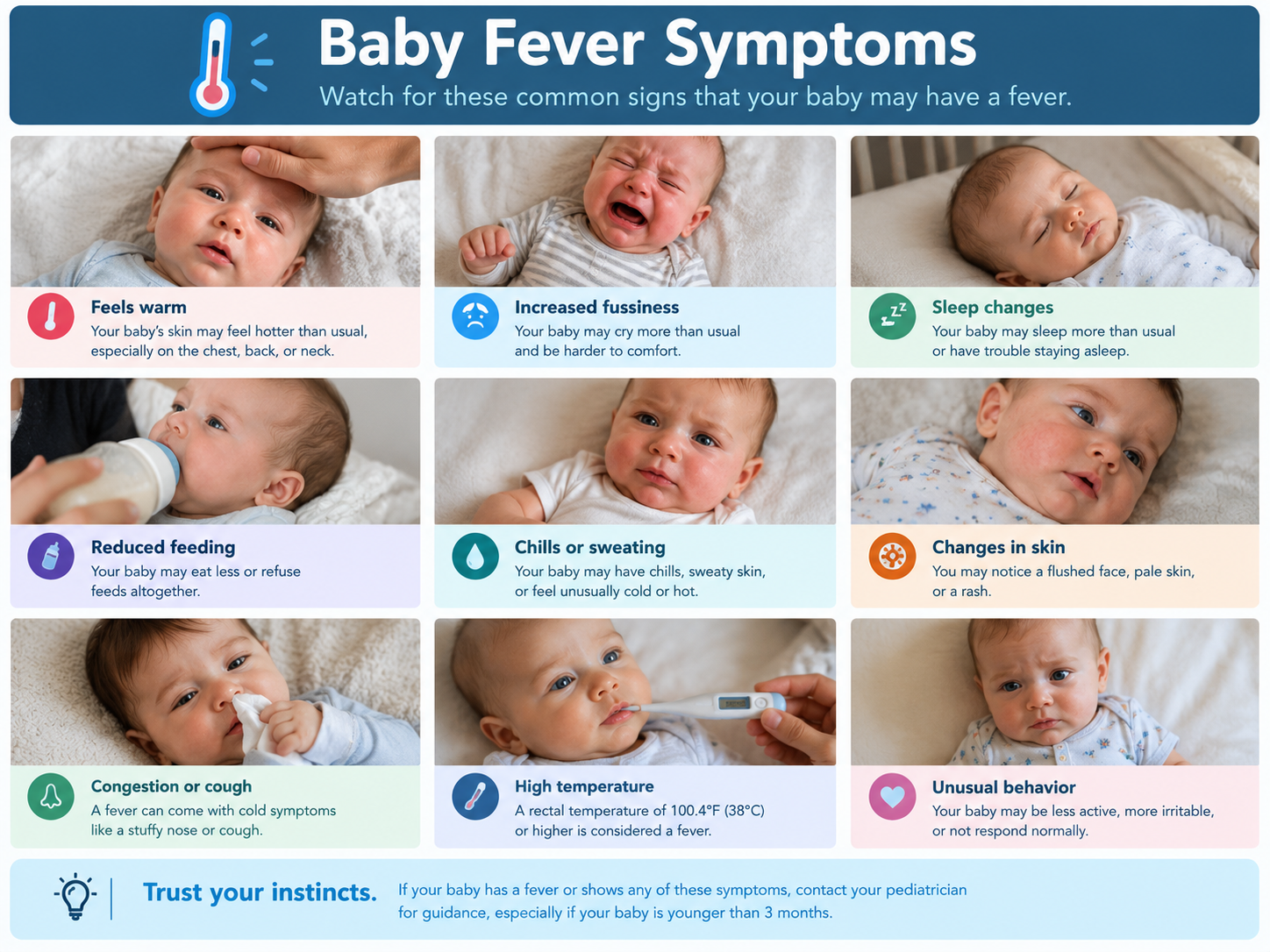
Baby fever symptoms to watch out for.
Baby Fever Medicine and Hydration
Baby fever medicine deserves careful attention because infants have smaller bodies and narrower dosing margins.
Use the exact product and dose recommended by your baby's healthcare professional.
Do not use adult medication for an infant. Do not estimate a dose with a kitchen spoon.
Use the measuring device supplied with the medication or another device recommended by your healthcare professional.
Hydration deserves observation during high temperature periods.
Continue breast milk or formula according to your baby's normal feeding pattern. Unless your healthcare professional gives different instructions.
Monitor wet diapers because urine output provides useful information about hydration.
If your baby repeatedly vomits fluids, refuses feeds, produces substantially fewer wet diapers, or appears unusually weak, contact a healthcare professional.
These signs matter regardless of whether the thermometer shows a dramatic fever.
How to Safely Reduce Baby Fever
Parents searching how to reduce baby fever often want a quick way to make the temperature normal.
The safer approach focuses on the underlying illness rather than trying to force the temperature back to a specific number.
Dress your baby comfortably rather than piling on blankets. Keep the room at a comfortable temperature. Offer normal feeds frequently.
Follow your pediatrician's medication instructions if medication is appropriate for your baby's age and condition.
Avoid aggressive cooling methods. Cold baths, ice, alcohol rubs, and excessive cooling are not appropriate fever treatments for infants.
Shivering increases discomfort and does not solve the underlying problem. A fever itself represents an immune response.
The American Academy of Pediatrics explains that fever occurs when the body's internal temperature regulation responds to illness by raising the body's temperature. [2]
The more useful question is not simply whether the fever disappeared.
Ask whether your baby is feeding, urinating, breathing comfortably, interacting normally, and showing improvement.
When Fever in Babies Requires Medical Attention
Fever in babies requires particular caution during the first months of life.
If your baby is younger than 3 months and has a rectal temperature of 100.4°F or higher, contact your healthcare professional immediately.
The American Academy of Pediatrics recommends immediate medical attention for a baby younger than 3 months with a temperature of 100.4°F, or 38°C, or higher. [1]
Seek emergency medical care when fever occurs alongside serious symptoms such as difficulty breathing, extreme sleepiness or difficulty waking, persistent vomiting that prevents fluid intake, a stiff neck, unusual unresponsiveness, or a sudden purple or bruise like rash. [3]
For older babies, contact your healthcare professional when your baby appears increasingly ill, refuses feeds, or becomes unusually lethargic.
Or develops breathing problems, has signs of dehydration, or has a fever accompanied by concerning symptoms.
Do not wait for the thermometer to reach an extreme number before seeking help. Your baby's behavior and physical condition deserve equal attention.

A pediatrician talking to a parent about reducing baby fever.
When Fever in Newborns Needs Immediate Action
Fever in newborns deserves a different level of caution because very young infants have a higher risk of serious bacterial infection.
A newborn with a temperature of 100.4°F or higher should receive prompt professional assessment.
The American Academy of Pediatrics developed specific guidance for well appearing febrile infants between 8 and 60 days old because serious infections require consideration even when a young baby initially appears well. [4]
This point also explains why advice from another parent might not apply to your baby.
Age, gestational history, symptoms, temperature method, vaccination status, and medical history all affect clinical decisions.
If your newborn feels hot, measure the temperature rather than relying on touch.
If the reading reaches the fever threshold, contact your baby's healthcare professional immediately.
Your Baby Fever Guide should always place newborn fever near the top of the priority list.
Waiting for additional symptoms is not an appropriate substitute for professional evaluation in a young infant.
A Practical Baby Fever Guide for Parents
A useful guide comes down to 4 questions.
How old is your baby?
What temperature did the thermometer show?
How was the temperature measured?
How is your baby acting?
Write down the temperature, time, measurement method, feeding pattern, wet diapers, and new symptoms.
This information gives your pediatrician a much clearer picture than saying your baby feels hot.
Keep a reliable baby fever thermometer available and learn how to use the device before your baby becomes sick.
Save your pediatrician's office number and after hours instructions on your phone. Knowing the process before a fever occurs reduces decision making under stress.
For baby fever temperature concerns, focus on accurate measurement. For baby fever symptoms, focus on behavior and physical changes.
For baby fever thermometer questions, use an age appropriate measurement method.
For fever in babies and fever in newborns, prioritize professional guidance when the infant is very young or appears seriously ill.
When you are deciding how to reduce baby fever or whether a baby fever reducer or baby fever medicine is appropriate, do not rely on a generic internet dose.
Use guidance specific to your baby's age, weight, health history, and symptoms.
A fever does not tell you the whole story. Your baby's age, behavior, hydration, breathing, feeding, and temperature measurement provide the context you need.
Save this Baby Fever Guide for reference, share it with another new parent, and contact your baby's healthcare professional whenever your baby's age or symptoms make you uncertain.
RELATED: Common Baby Illnesses Parents Need to Know
References
American Academy of Pediatrics, HealthyChildren.org. Fever and Your Baby. Guidance on infant fever thresholds, temperature measurement, causes, and newborn fever.
American Academy of Pediatrics, HealthyChildren.org. Fever Without Fear: Information for Parents. Guidance on fever physiology and general fever management.
American Academy of Pediatrics, HealthyChildren.org. Urgent Care, ER or Pediatrician? A Parent Guide. Guidance on emergency warning signs associated with fever.
Pantell RH, Roberts KB, Adams WG, et al. Evaluation and Management of Well Appearing Febrile Infants 8 to 60 Days Old. Pediatrics. 2021. American Academy of Pediatrics clinical practice guideline.
