How to Soothe a Baby with Colic

Parent holding a fussy baby in a carrier during evening colic.
To soothe a baby with colic, swaddle your baby, hold the side or stomach position while awake, shush near the ear, swing gently, and offer a pacifier. Try a carrier, leg bicycle motions, paced feeding, and a warm bath. Colic starts near 2 to 3 weeks and fades by 3 to 4 months.
RELATED: How to Get Your Baby to Sleep Faster (digital e-book)
Your baby screams for hours and nothing works. Feeding, changing, rocking, pacing the hallway, and the crying continues.
Colic is real, and you did not cause it. Get back some well needed shut-eye.
This guide covers how to soothe a baby with colic, what causes colic in babies, and how colic vs baby gas differ, so you know what to try tonight.
How to Soothe a Baby with Colic
Start with the 5 S method from pediatrician Dr. Harvey Karp.
Swaddle, hold your baby on the side or stomach while awake, shush, swing, and offer a pacifier to suck.
Place your baby on the back for every sleep, and stop swaddling when rolling begins.
Make the shush loud, close to the volume of a running shower, and keep it near your baby's ear.
Give each step two full minutes before you switch.
Wear your baby in a carrier during the evening stretch, since warmth and motion calm many babies and free your hands.
After a feed, move your baby's legs in a slow bicycle motion.
A warm bath eases colicky abdominal pain for some babies, and awake tummy time helps others. Log what works in your phone for one week.
Crying does not harm your baby. Shaking does. [1]
Patterns show up fast. Observe any noticeable changes in behavior.
When your patience runs thin, lay your baby on the back in the crib, close the door, and step away for five minutes.
When Does Colic Start
There is the onset, peak and the resolution. The phase will pass, that is what to focus on when things get hard.
So take note of the 2-6 weeks after birth that colic may be a possibility.
The resolution phase will surely follow soon after.
Colic usually starts between 2 and 3 weeks of age. Crying builds toward a peak near week 6.
Episodes cluster in the late afternoon and evening, often at the same hour each day.
Doctors use the colic definition known as the rule of threes: crying for more than 3 hours a day, on more than 3 days a week, for more than 3 weeks. [2]
Premature babies start later, timed to adjusted age, not birth date.
Call your pediatrician if crying begins in the first week or first appears after 5 months. Both patterns point to a different cause.
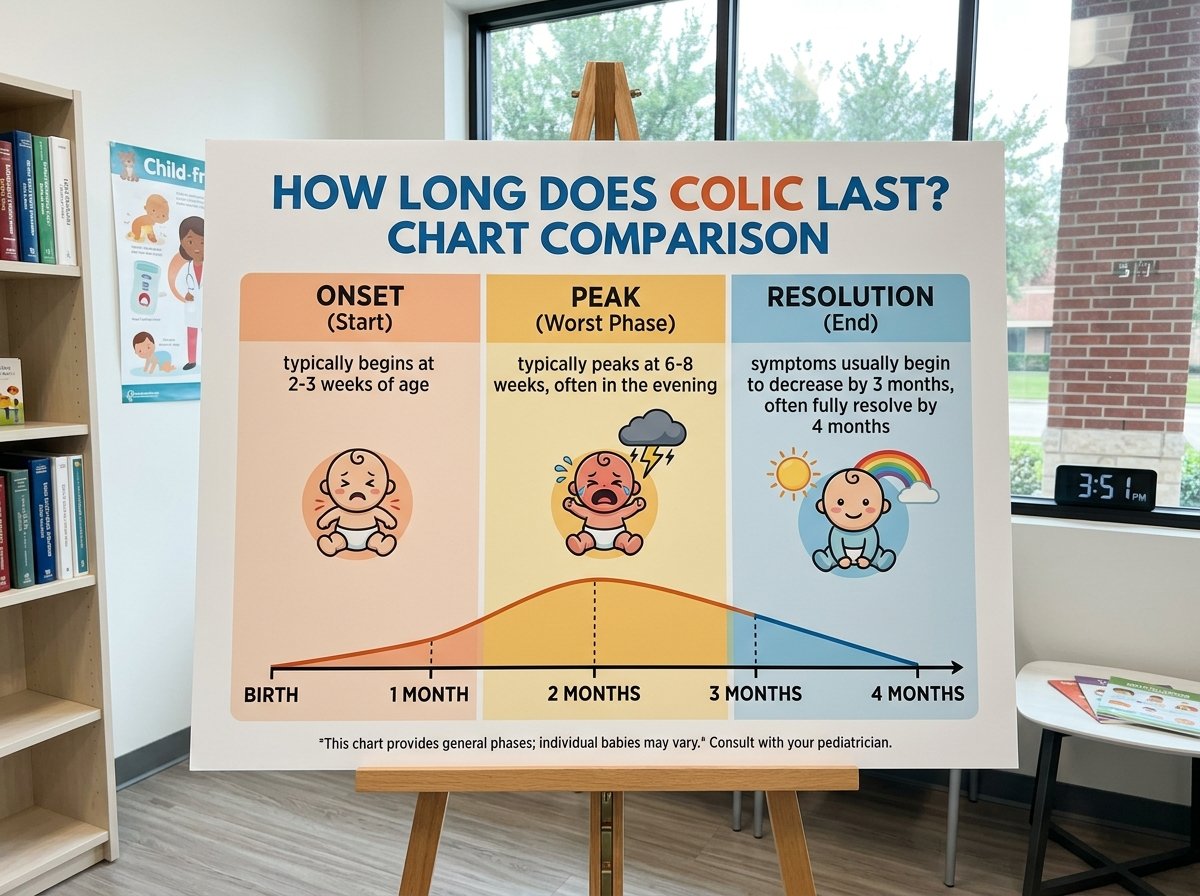
How long does colic last chart comparison.
How Long Does Colic Last
Most cases fade by 3 to 4 months, and nearly all end by 5 months. Expect a slow decline, not an overnight stop.
Around weeks 8 to 10, you will notice longer calm stretches, though a rough evening still follows a few good ones.
Studies estimate up to 20 percent of infants meet the criteria, so you are far from alone. [1]
Ask when does colic start in your baby's case, then count roughly 12 weeks forward.
How long does colic last matters less than how you share the shifts. Don’t be afraid to ask family for help.
Hand your baby to a partner, relative, or friend for one evening block each week, and sleep.
As hard as it may be, try to prioritize your sleep. Family and friends will be happy to spend time with the little mini tornado.
The colic meaning, a label for unexplained crying in a healthy baby, says nothing about danger.
Crying past 5 months deserves a pediatric visit to check for reflux, allergy, or an ear infection.
What Causes Colic in Babies
Nobody knows the exact cause. Researchers point to several contributing factors.
The nervous system of an immature gut overreacts to normal digestion.
Gut bacteria in colicky babies differ from those in calm babies.
Swallowed air during fast feeds adds pressure, and overfeeding stretches a small stomach.
A small number of cases point to lactose intolerance, a cow's milk protein allergy.
Babies also struggle to settle their own nervous system. So light, noise, and touch overwhelm them by evening.
The colic meaning comes from the Greek word kolikos, which refers to the colon, so the name points to the gut, yet the pain source remains unproven.
Your diet, your parenting style, and your baby's temperament do not cause colic. [1]
Parents describe colicky abdominal pain when they see clenched fists, legs pulled to the chest, and a hard belly.
Watch for these colic symptoms: high pitched crying, a red face, an arched back, and no relief from feeding or holding.
Formula for Colicky Babies
Change formula only after a pediatrician visit. Most colicky babies do not need a new brand. Try paced feeding first.
Hold your baby upright, keep the bottle near horizontal, and pause every few sips so your baby swallows less air.
Then check your bottle.
Anti colic bottles use vents or internal tubes to cut swallowed air. Research on them is limited, but the cost is low and many parents report calmer feeds.
Compare anti colic bottles by how easily you clean them, since a vent with five pieces gets skipped at 3 a.m.
A formula for colicky babies should follow a diagnosis, not a guess.
If you breastfeed, ask your doctor about drops with the probiotic Lactobacillus reuteri DSM 17938, which has shown benefit in trials. [1]
If your doctor suspects cow's milk protein allergy, the standard test is a one to two week trial of an extensively hydrolyzed formula.
Blood in the stool, eczema, or repeated vomiting raise suspicion. Soy and partially hydrolyzed options lack strong support.
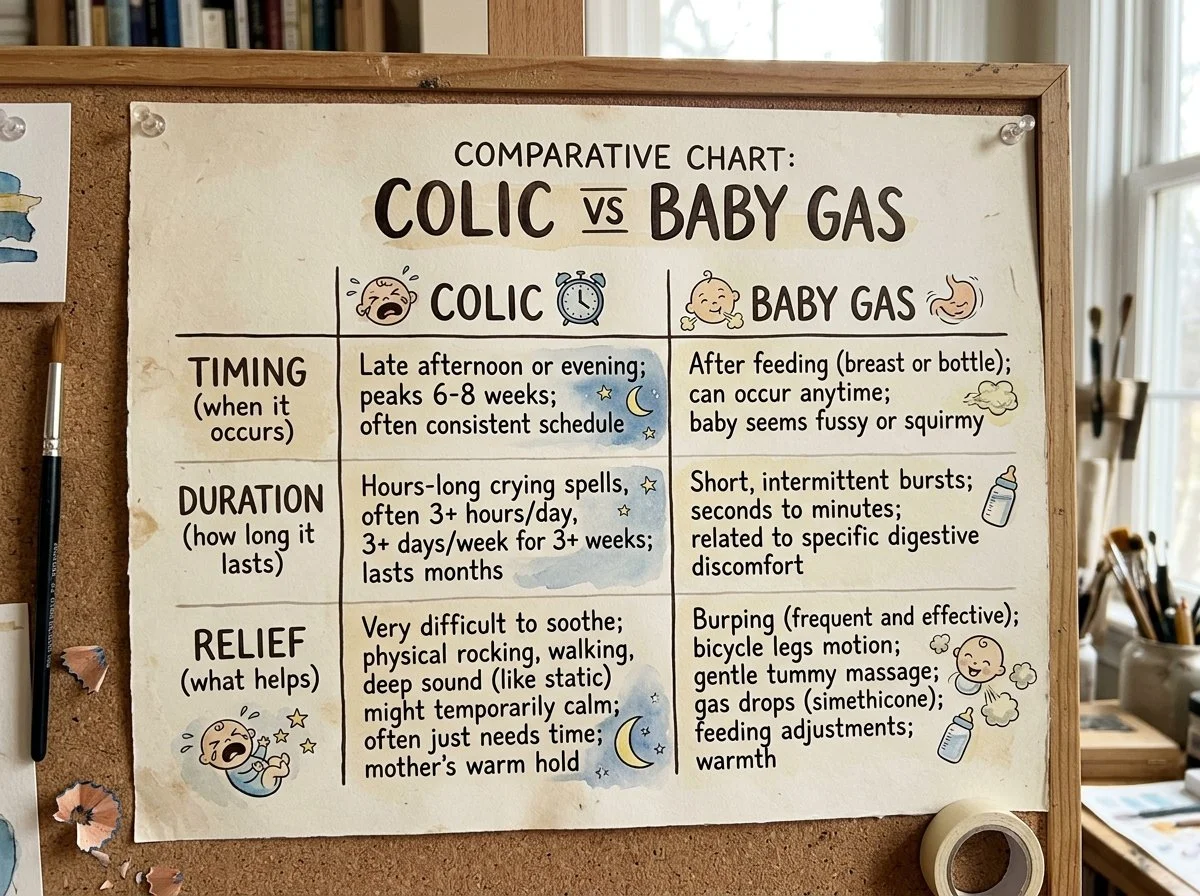
Chart comparing colic vs baby gas by timing, duration, and relief.
Colic vs Baby Gas
Gas passes. Colic persists. A gassy baby squirms, then finds relief after a burp or bowel movement and settles within minutes.
A colicky baby cries hard for hours with no clear trigger, then calms down for no obvious reason.
Gas appears at any hour. Colic follows a schedule.
Between episodes, a colicky baby looks content, feeds well, and gains weight.
Gas mimics some colic symptoms, such as squirming and a tight belly, so measure duration and relief.
Colic vs baby gas comes down to those two signs. Under the colic definition, a baby with poor feeding or weight loss does not qualify.
Simethicone drops show no benefit over placebo in trials, so skip them.
Call your pediatrician for a fever of 100.4 F or higher, green vomit, blood in the stool, a swollen belly, or poor weight gain. Any of these signs rules out simple colic. [1]
Your plan begins this evening. Use the 5 S method (swaddle, side, shush, swing, suck) by Dr. Harvey Karp. Share evening shifts and keep notes.
Knowing when does colic start and how long does colic last, and reviewing what causes colic in babies, so you stop taking the crying spells personally.
Treat colicky abdominal pain with holds, warmth, and movement. Try paced feeding and anti colic bottles before you change formulas.
Match colic symptoms against the colic definition, and call your pediatrician about any warning sign.
Temporary colic meaning mom and dad are uneasy for a bit is no fun. Rest assured, your baby will outgrow the pattern.
How to soothe a baby with colic gets easier. Follow a solid plan of action. Share this guide with your partner tonight, then book a pediatric visit to review your baby's crying pattern.
RELATED: Is it Bad for a Baby to Walk Early?
References:
[1] Johnson JD, Cocker K, Chang E. Infantile colic: recognition and treatment. American Family Physician. 2015;92(7):577 to 582. Supports the sections on soothing, duration, causes, formula and probiotics, and colic vs baby gas.
[2] Wessel MA, Cobb JC, Jackson EB, Harris GS, Detwiler AC. Paroxysmal fussing in infancy, sometimes called colic. Pediatrics. 1954;14(5):421 to 435. Supports the rule of threes in the when does colic start section.
