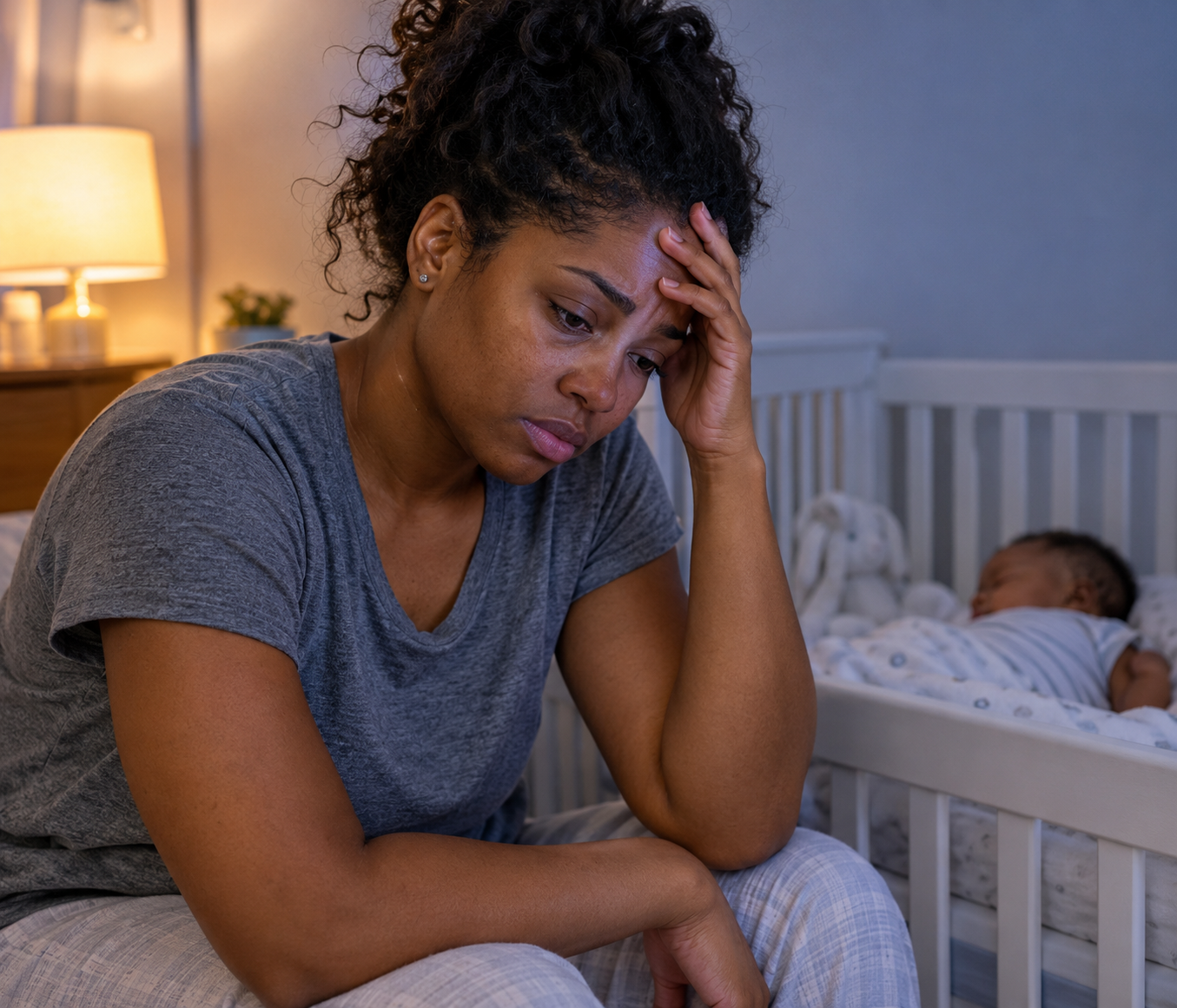
Exhausted parent reflecting the anxiety and mental strain of repeated nighttime waking.
Can't Sleep When Baby Sleeps?
A lot of parents just can't switch off. The worry about the baby never stops. Maybe they're anxious all the time. Maybe they're up half the night. Maybe they're terrified they'll miss some warning sign. What actually helps is a simple plan for the baby's care . Not running to the crib every five minutes, and calling a professional when worry won't quit. Do those things and parents get some control and sleep back.
RELATED: Baby’s First 12 Months | Everything…About Your Baby’s 1st Year
You finally get your baby to sleep and you're awake. Listening for every creek and peeking at the monitor constantly.
After weeks of nights interrupted, you feel exhausted yet your mind is racing and refuses to settle.
Postpartum sleep anxiety, persistent nighttime alertness, and emotional exhaustion deserve more attention than generic advice to sleep whenever your baby sleeps.
Can't Sleep When Baby Sleeps: Why Your Mind Stays Awake
The advice to rest whenever your baby rests overlooks a difficult reality. Sleep requires more than an available opportunity.
You also need enough physical comfort and mental calm to fall asleep. After repeated nighttime interruptions, you might remain alert even during a quiet stretch.
You listen for changes in breathing, anticipate another cry, or mentally prepare for the next feeding. When your baby finally settles, your mind still expects another interruption.
Research supports a relationship between infant sleep difficulties and maternal well-being.
A study of 171 families found associations between maternal mental health, reported infant night waking, and bedtime distress.
These findings suggest a two way relationship rather than a simple explanation in which one problem always causes the other. [1]
The researchers also found differences according to family stress and other circumstances.
Postpartum Sleep Anxiety: When Rest Feels Difficult
Postpartum sleep anxiety describes worry or tension around sleep after childbirth.
Some parents fear missing a cue, not hearing their baby, or not being able to respond fast enough.
Others feel uneasy when the house becomes quiet because quiet removes the immediate task of caring for the baby and leaves room for intrusive worries.
Try to separate a real caregiving responsibility from a repeated mental check.
Confirm your baby is sleeping somewhere safe and follow what your pediatrician says.
Agree with your support person on who handles the next response.
Once that's clear, remind yourself you don't need to stay awake just to prove you're attentive.
If worry, panic, or trouble sleeping sticks around even when another adult takes over, talk to a healthcare professional.
Hypervigilance After Having a Baby: Always Being on Alert
Hypervigilance after having a baby refers to a heightened state of alertness.
A parent might wake at tiny noises, repeatedly check a monitor, or feel unable to stop scanning for possible problems.
Some awareness is expected when caring for an infant. Concern rises when alertness becomes relentless, interferes with rest, or feels impossible to control.
Researchers examining maternal mental health and infant sleep have discussed hypervigilant behaviors in relation to anxiety and parents' perceptions of infant distress.
These findings do not mean every attentive parent has a mental health condition.
They do show why persistent alertness deserves a thoughtful response rather than criticism or dismissal. [2]
A useful first step is to notice the behavior without judging yourself.
How often do you check the monitor after confirming your baby is safe?
Do you wake before your baby makes a sound?
Does another person's reassurance help, or do you feel compelled to check again?
These patterns give you and your clinician a clearer picture of what is happening.
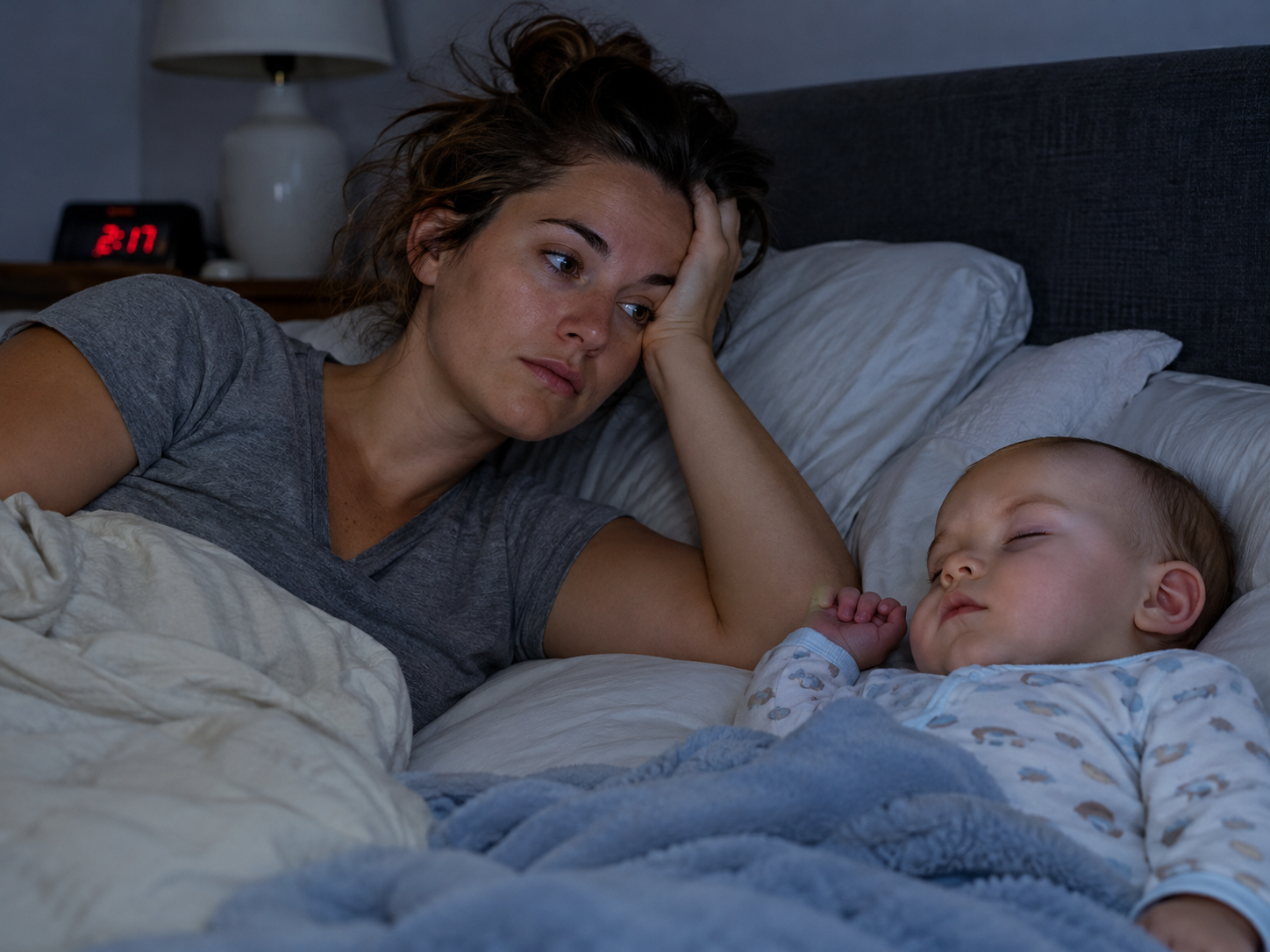
Exhausted parent awake beside a sleeping baby.
Anxiety When Baby Is Sleeping: Why Quiet Does Not Always Bring Relief
Anxiety when baby is sleeping often catches parents off guard.
You might feel ready to embarrass any challenges during the day because your attention has a clear purpose.
At night, fewer distractions leave room for wandering thoughts about breathing, illness, feeding, development, or the child moving into a regression stage.
Repeated checking can provide a sense of relief, only to be followed up by another pressing urge to check again.
Does reassurance settle your concern for a reasonable period? Or does the relief disappear almost immediately?
If there is a recurring pattern, discuss your worries with your doctor or mental health provider. They will know the next best steps.
Don’t let the mental and physical exhaustion become overwhelming before you act on it.
Always Listening for Baby at Night: The Cost of Interrupted Rest
Always listening for baby at night means using your focused attention, even while you are trying to rest.
You might interpret ordinary household noises as crying or wake fully after a small movement from the crib.
After repeated interruptions, bedtime itself might begin to feel like a period of waiting rather than an opportunity to sleep.
Instead of relying on constant monitoring as your only source of reassurance, establish a clear plan with your partner or another trusted caregiver.
Agree on who responds during each shift, and which sounds require attention. Establish how you will communicate concerns.
Follow safe sleep guidance and your baby's medical care plan. Divide responsibility to help reduce uncertainty without ignoring legitimate safety needs.
Sleep Deprivation and Emotional Regulation: Why Small Problems Feel Bigger
Sleep deprivation and emotional regulation are closely connected. Insufficient, fragmented sleep affects attention, patience, decision making, and the ability to manage stress.
A minor inconvenience might trigger tears or anger after several disrupted nights.
You might also struggle to remember simple tasks or feel less able to cope with demands you previously handled comfortably.
A longitudinal study following 1,460 mother and infant pairs found an association between persistent severe infant sleep problems and later emotional difficulties in children.
This study does not prove that parental sleep loss directly caused those outcomes, nor does it establish the same effect for every family.
It reinforces the importance of taking persistent sleep problems seriously and supporting family well-being. [3]
When your patience feels unusually thin, treat the change as information rather than a character flaw.
Reduce nonessential tasks, ask another adult to cover a caregiving shift, and avoid making major decisions when severely sleep deprived.
If you feel too exhausted to care for your baby safely, place your baby in a safe sleep space and seek immediate help from a trusted adult.
Parental Anxiety at Night: Recognizing the Pattern
Parental anxiety at night is more noticeable after the sun goes down and the home settles.
You might ponder the day's decisions. Anticipate tomorrow's demands. Or worry whether or not your baby is getting enough sleep.
These thoughts feel more urgent when little energy is left to challenge them. Anxious dread is next to creep up.
If you experience parental anxiety at night, write down recurring concerns earlier in the evening. Next, identify one action for each concern to address.
For example, prepare feeding supplies before bedtime rather than mentally rehearsing the task for an hour. Prepping is key.
If the same fear returns despite reassurance, postpartum sleep anxiety may be the culprit. It is wise to visit a qualified professional.
Waking Up Before Baby Every Morning: When Your Body Expects an Interruption
Waking up before baby every morning is your internal clock at work. It’s proof your body has adapted to your baby's schedule.
The pattern may sometimes reflect accumulated sleep loss, stress, or heightened alertness.
You might wake before the alarm, listen for movement, and struggle to fall asleep again even though your baby remains quiet.
Track your bedtime, awakenings, morning wake time, caffeine intake, and daytime energy for one week.
This record helps you identify patterns without guessing. Reverse engineer why you feel the way you do.
If you’re waking up before baby every morning and are chronically exhausted, discuss the pattern with your healthcare provider.
Especially when worry or low mood accompanies the sleep disruption. It could be more than your internal clock.

Parent sitting at a kitchen table with feelings of postpartum sleep anxiety.
New Parent Mental Exhaustion: More Than Feeling Tired
New parent mental exhaustion involves the cognitive and emotional work of caring for a baby. Not only the number of hours you sleep.
You remember feeding times, monitor supplies, arrange appointments, interpret cries, and anticipate the next interruption.
Even when another person handles a feeding or two, your mind continues micromanaging the entire routine.
Research examining perceived toddler sleep problems found associations with maternal sleep and mental health.
These findings highlight how a child's sleep difficulties can affect a mother's well-being beyond nighttime awakenings. [4]
Reduce this invisible workload by assigning complete responsibilities rather than requesting occasional help.
For example, another caregiver might own a specific overnight shift, including settling the baby and recording relevant feeding details.
New parent mental exhaustion often feels harder to manage when you remain responsible for planning and supervising every task.
Can't Relax When Someone Else Watches Baby: Why Delegating Feels Difficult
Can't relax when someone else watches baby is a common way parents describe difficulty handing over responsibility.
You might repeatedly check your phone, ask for updates, or feel compelled to return home early.
Sometimes this reflects a genuine lack of trust in the caregiver.
Other times, anxiety continues even when the person is reliable and the baby is safe. Start with a clearly defined handoff.
Explain essential care instructions, agree on when updates are needed, and choose a short period for yourself without checking repeatedly.
If you can't relax when someone else watches baby despite appropriate reassurance, consider discussing the worry with your healthcare provider.
Can't Sleep When Baby Sleeps: When to Seek More Support
Can't sleep when baby sleeps becomes more concerning when you have opportunities to rest but don’t.
Remaining awake for long periods, feel persistently frightened, or struggle to function during the day.
A parent who is always listening for baby at night needs support when the behavior interferes with daily life.
Likewise, hypervigilance after having a baby deserves professional assessment when constant alertness feels uncontrollable.
Contact your doctor or a qualified mental health professional if anxiety, low mood, intrusive thoughts, or sleep difficulties persist or worsen.
Seek urgent help if you fear you might harm yourself or your baby, or feel unable to keep either of you safe.
Persistent symptoms deserve attention without waiting for a crisis.
Protect Your Rest and Your Well-Being
Can't sleep when baby sleeps does not mean you are failing at parenthood.
Postpartum sleep anxiety, nighttime alertness, and new parent mental exhaustion deserve recognition alongside your baby's sleep needs.
Set clear caregiving shifts, reduce unnecessary checking, and track persistent sleep problems.
Seek professional support when symptoms interfere with daily life.
Visit NewParentSteps.com for more informed guidance on navigating your baby's development while protecting your own well-being.
RELATED: 10 Sleeping Tips for New Parents
References:
[1] Goldberg, W. A., Lucas-Thompson, R. G., Germo, G. R., Keller, M. A., Davis, E. P., and Sandman, C. A. (2013). Eye of the beholder? Maternal mental health and the quality of infant sleep. Social Science & Medicine, 79, 101–108. https://doi.org/10.1016/j.socscimed.2012.07.006
[2] Maternal Mental Health Symptom Profiles and Infant Sleep: A Cross-Sectional Survey. (2022). Available through PubMed Central. https://pmc.ncbi.nlm.nih.gov/articles/PMC9319039/
[3] Cook, F., Conway, L. J., Giallo, R., Gartland, D., Sciberras, E., and Brown, S. (2020). Infant sleep and child mental health: A longitudinal investigation. Archives of Disease in Childhood, 105, 655–660. https://doi.org/10.1136/archdischild-2019-318014
[4] Covington, L. B., Armstrong, B., and Black, M. M. (2018). Perceived Toddler Sleep Problems, Co-sleeping, and Maternal Sleep and Mental Health. Journal of Developmental & Behavioral Pediatrics, 39(3), 238–245. https://doi.org/10.1097/DBP.0000000000000535
